

After a storm has made its way across your property, do your trees show the signs? You may be concerned over a branch that could come down on the house or car, or even on a member of your family. Then there is the matter of what one should be on the lookout for when making a tour of the yard in the wake of bad weather.
Homeowners in Central Arkansas put these questions to us with some frequency. We are here at Paquette’s Tree Service to assist in identifying storm damage and head off any larger issues. If you want to discuss what you have observed, pick up the phone at (501) 881-2681.
There is no getting around the fact that storms in this part of Arkansas can be hard on a tree. Between the wind, the rain and ice, not to mention lightning, they will have their effect. In some cases the damage is plain to see but warning signs can be overlooked until the point of no return. Here is what to be aware of.
Damage in the Canopy: Look Up First
A storm will make short work of the top of a tree. The telltale sign is a broken limb left hanging; if it is still in the branches above it is a hazard. One does not want to go about pulling those “widow-makers” down on one’s own, so best to stay clear.
Pay attention to the following in the canopy:
- Any large limbs split from the trunk
- Bare patches where the wind has denuded the leaves and smaller branches
- A lopsided or thinned out crown
- Branches that have been put out of position and are now rubbing or crossing
- Broken branches yet to fall
Trunk and Main Structure
Serious trouble lies in the trunk, the tree’s backbone. A crack or split can undermine the entire tree and spell failure in the next storm. Do not be fooled by a small looking surface crack as it may go deep.
Red flags to note in the trunk:
- Splits or vertical cracks in the bark
- Bark that has been torn or peeled
- Lightning scars from top to bottom
- A hollow spot from wood decay
- Any new leaning
If a tree has started to lean after a storm, take notice. It is an unmistakable red flag; trees do not simply shift overnight without some structural or root problem.
The Roots
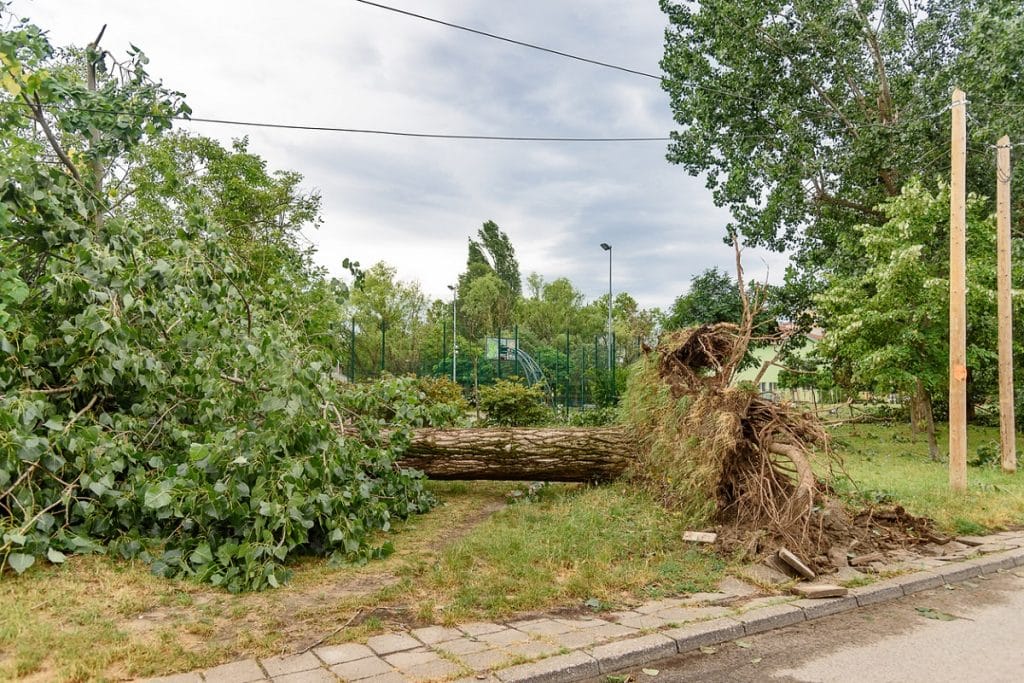
You can miss what is happening below ground. The roots are what keep the tree in place and a combination of hard rain and wind can dislodge them.
- Mounding or heaving of soil to one side
- Exposed or torn roots
- Water pooling at the base
- An opening between the ground and the trunk
It is a deceptively healthy looking tree on top whose anchor has given way, and one with damaged roots can go down with little forewarning.
A Sick Tree
Stress from a storm can hasten what was already in the making. In the weeks to come you might see leaves browning and falling out of season, fungus on the trunk, or a branch that has ceased to put on leaves. These would indicate the tree is having a hard time of it.
Call in a Professional
Raking up some debris is fine, but we would not put it to you that it is wise to put yourself under a hanging branch or mount a ladder for a broken one. Let our crew do it. With 15 years in the business between us, the team at Paquette’s goes about every job with an eye for safety and a consistent approach.
We have a 24/7 availability because a storm is not going to wait for us to open for business. Our services extend to residential and commercial properties in all of Central Arkansas, from Little Rock and North Little Rock to Hot Springs, Malvern, Conway, Pine Bluff, Benton, Sherwood, Jacksonville, Bryant and beyond. We also employ sustainable methods in the care of your property.
Do not let the next storm make a bad situation worse if you have seen any of the above. For a free estimate and consultation, contact Paquette’s Tree Service at (501) 881-2681. We will put together a plan to ensure the safety of your family and your trees after we have had a look at the damage.